

Get your Heat Stress & Cold Stress certificate online in 2 hours. WorkSafeBC OHS Reg 7.27-7.35, Alberta OHS Code Part 33 & Ontario Bill 190 (2024) aligned. Only $49.99 with instant certificate. Our combined Heat Stress & Cold S...
What you get
CA$49.99
one-time, per person
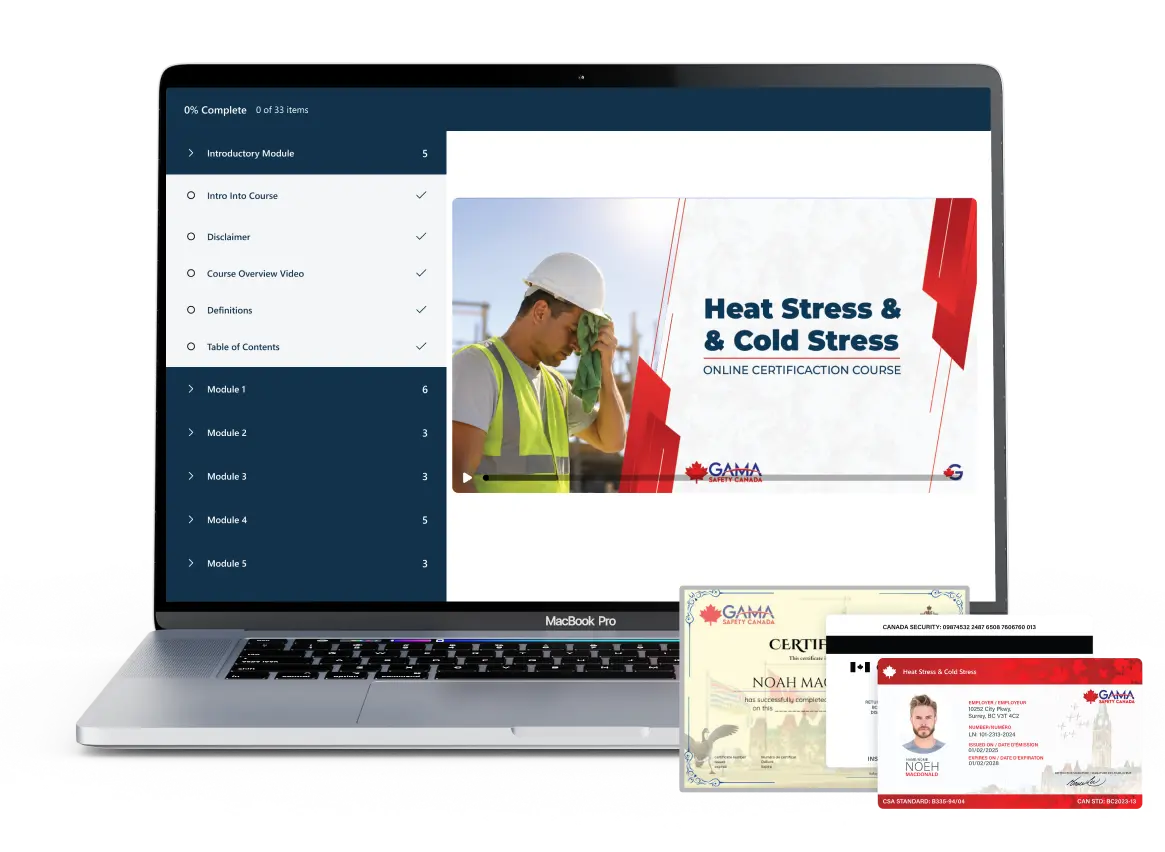
Get your Heat Stress & Cold Stress certificate online in 2 hours. WorkSafeBC OHS Reg 7.27-7.35, Alberta OHS Code Part 33 & Ontario Bill 190 (2024) aligned. Only $49.99 with instant certificate.
Our combined Heat Stress & Cold Stress course covers both thermal hazards in one purchase — perfect for outdoor workers exposed to Canadian summers AND winters. Learn heat exhaustion vs heat stroke recognition, cold stress (hypothermia, frostbite, chilblains), ACGIH TLV/WBGT limits, work-rest schedules, hydration and warm-up requirements, PPE selection, and emergency response. Aligned with WorkSafeBC, Alberta OHS, Ontario OHSA, and Ontario Bill 190 (2024) requirements. After the 2021 BC Heat Dome killed 619 people in less than a week, thermal exposure training is one of the most enforced items in provincial workplace inspections. Study on any device — desktop, tablet, or mobile — at your own pace. Instant digital certificate + physical wallet card mailed to your address free of charge. Trusted by construction, landscaping, roofing, oil & gas, forestry, agricultural, and outdoor workers across Canada.
For individual purchase
For business purchase
In June 2021, the BC Heat Dome killed 619 people in less than a week — one of the deadliest workplace-safety events in modern Canadian history. Every year, Environment Canada records rising average temperatures, and WCB claims for heat exhaustion and heat stroke have climbed sharply. Cold stress is equally deadly on the other end of the year — hypothermia and frostbite claim Canadian lives every winter, especially in oil & gas, utility, and construction operations. Under WorkSafeBC OHS Regulation Part 7 (Sections 7.27-7.35), Alberta OHS Code Part 33 (Working at Extreme Temperatures), Ontario OHSA + Bill 190 (2024), and federal Canada Labour Code Part II, every employer must protect workers from thermal exposure with a hazard assessment, hydration or warm-up program, work-rest schedules, and mandatory worker training.
Gama Safety Canada's Online Heat Stress & Cold Stress course delivers both certifications in one purchase for only $49.99 — one course that covers Canadian workers year-round. Complete on any device at your own pace, pass the final exam, and download your certificate instantly. Physical wallet card mailed to your address at no extra charge. Aligned with ACGIH TLVs (Threshold Limit Values) and WBGT (Wet Bulb Globe Temperature) — the technical standards recognized by every Canadian WCB. Designed for outdoor construction workers, landscapers, roofers, oil & gas field crews, forestry workers, road maintenance crews, utility line workers, and any employer with outdoor or thermally-hazardous workplaces.
Canadian summers are getting hotter and Canadian winters more extreme — and the workplace death toll from thermal exposure is climbing every year:
Thermal exposure training is legally required, but more importantly it's life-saving. This course is designed to give workers and supervisors the recognition skills and prevention protocols they need to survive Canada's changing climate.
Any Canadian worker exposed to hot or cold environments needs thermal exposure training. That covers most outdoor work, plus a lot of indoor work. This course is built for:
Every Canadian province regulates thermal exposure — with recent legislative changes making enforcement stronger than ever:
Most workers complete the course in 90 to 120 minutes and receive their digital certificate immediately after passing the final exam. Here's the process:
Heat and cold stress are the defining hazards for outdoor workers. Our Landscaper / Outdoor Worker Bundle combines 7 essential courses — including Heat & Cold Stress, Chainsaw Safety, PPE, and more — for $195 (regular $267.69, save $72.69). It's the complete outdoor worker starter pack for landscapers, groundskeepers, roofers, road crews, and forestry workers.
Other bundles that may fit your work:
If you prefer to buy courses individually, these are the most common companion courses for outdoor and thermally-exposed workers:
Managing outdoor safety for 10, 50, or 500+ workers? We offer volume pricing for corporate Heat & Cold Stress training with a business dashboard so your HR and safety team can assign seats, track completions, and pull WCB compliance reports in real time. Ideal for construction contractors, landscaping companies, roofing firms, oil & gas operators, utility companies, forestry contractors, agricultural producers, and multi-site outdoor employers. Visit our Train Your Team page or contact us at +1 866-661-9803 or info@gamasafety.ca for corporate quotes and multi-course bundle pricing.
This certificate is accepted and recognized in:
OHS Compliant
Certificate of Completion
Online Course
Everything below is included in the one-time price. No subscriptions, no hidden fees.
Course length
2 hr 0 min, self-paced. Stop and continue anytime.
Any device
Desktop, tablet or phone. Your progress saves automatically.
Instant access
Start the course right after checkout, 24/7.
Unlimited exam retakes
Didn't pass? Try again for free, as many times as you need.
Instant certificate
Download and print your certificate the moment you pass.
Wallet card mailed free
A durable physical wallet card, mailed to you at no extra cost.
Multiple languages
English, French, Spanish, Mandarin, Hindi, Punjabi and more.
Recognized across Canada
OHS compliant and accepted in every province and territory.
Real support
Call 1-866-661-9803 or email info@gamasafety.ca.
Four simple steps from sign-up to certificate.
Register
Create your account and start right away.
Complete Training
Work through the modules at your own pace.
Pass the Exam
Score 80% or better. Unlimited free retakes.
Get Certified
Download your certificate instantly. Wallet card mailed free.
Same trusted certificate, two ways to buy.
For myself
For my team
This online course is perfect for:
CA$49.99
one-time · 1 course
See our range of over 40 online courses that are fully accredited and trusted. You can do them online, on campus, or on site.
Better to lose a minute of your life than to lose your life in a minute.
Get the training you need today, online in minutes or hands-on with our instructors.