
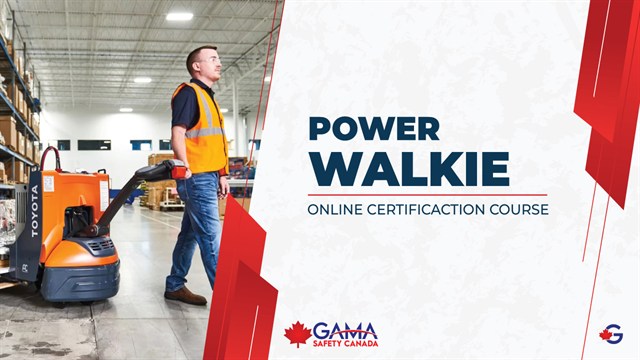
A power walkie, or electric pallet jack, is a powered machine, so operators in Canada need training and a hands-on practical evaluation before they use one at work. The online course covers the theory, such as pre-use checks, safe operating practices and battery care, and the practical evaluation on the machine proves you can run it safely. This guide explains how power walkies work, the main hazards, and how to get certified.
What is a power walkie?
A power walkie is a battery-powered machine that lifts pallets a few inches off the floor and moves them at ground level. It is the powered version of a manual pallet jack. You steer and control it with a tiller handle that has the throttle, horn, lift and lower buttons, and a safety reverse button on the end.
There are two common styles:
- Walkie models, where the operator walks behind or beside the machine.
- Walkie-rider models, where the operator can ride on a fold-down platform for longer trips.
Power walkies are used every day in warehouses, distribution centres, grocery and retail stockrooms, cold storage and factories. They look simple, and that is part of the danger. Because they are easy to drive, people often use them with little or no training.
The main power walkie hazards
Most power walkie injuries happen to the operator or to someone standing close by. The main hazards are:
Crushed feet
The machine or load can roll over feet, especially when pulling it toward you.
Pinch points
An operator can be pinned between the tiller handle and racking, a wall or another load.
Collisions
Hitting people, racking or products in busy aisles, at corners and around dock doors.
Other risks include loads that shift or fall, runaway machines on ramps, falling off a loading dock edge, and battery charging hazards such as acid and gas. Safety boots, a steady walking pace and good body position go a long way. Walk to the side of the tiller, not directly in front of it. Keep your feet clear of the frame. Slow down at corners and sound the horn at blind spots.
Ramps and docks need extra care. Go slowly, follow the operator’s manual for travelling up and down grades, and never turn on a ramp. Check that a trailer is secured and the dock plate is in place before you drive onto it.
Battery charging has its own hazards. Charge only in the marked charging area, which should be well ventilated with no smoking or open flames. Wear the PPE your employer requires, such as eye protection and gloves, when handling batteries, and know where the eyewash station is. Report damaged cables, leaks or swelling batteries instead of using them.
The rules in plain words
Provincial OHS regulations require employers to make sure workers who operate powered equipment are trained and competent on it. For a power walkie, that usually means:
- You understand the theory: controls, pre-use checks, safe operating practices, loads, batteries and emergencies.
- You have passed a hands-on practical evaluation on the machine you will use.
- You know your site’s traffic routes, rules and procedures.
An online course covers the theory only. It does not make you a certified operator on its own. Many people think a power walkie is “just a pallet jack” and does not need training. Because it is powered, it does.
Get your Power Walkie certificate today
100% online · unlimited free retakes · instant certificate + free wallet card
Who needs power walkie training?
Anyone who uses or will use a power walkie or walkie-rider at work, and the supervisors who oversee them. Common jobs include:
New hires often take the course to get ready for their practical evaluation, and experienced operators use it as a refresher.
What the online course covers
The Gama Safety Power Walkie course takes about four and a half hours and has seven modules:
- Introduction to Power Walkies: what a power walkie is, the main types and parts, and common hazards.
- Pre-Operational Checks: forks, wheels, tiller handle, brakes, horn, battery and controls before every shift.
- Safe Operating Practices: speed, tiller position and body placement to avoid pinch points, foot injuries and collisions.
- Handling and Manoeuvring: picking up, moving and setting down loads in aisles, around corners, on ramps and at loading docks.
- Battery Maintenance: safe charging, battery care, and the PPE and precautions for handling batteries.
- Emergency Procedures: what to do if the machine malfunctions, a load falls or someone is hurt.
- Practical Training: what the hands-on evaluation involves, so you are ready to show safe operation.
Online theory vs hands-on evaluation
Power walkie certification has two parts:
- Online theory (this course): learn at your own pace, pass the final exam and get a certificate that shows you completed the theory.
- Hands-on practical evaluation: you show a qualified person that you can inspect the machine, drive it, handle loads and park it safely on the actual machine you will use.
The practical evaluation is done by your employer or a qualified evaluator. Gama Safety also offers hands-on power walkie training at our Burnaby, BC training centre or at your site. Doing the theory online first means the practical part can focus on the machine and your site.
Does power walkie certification expire?
There is no single national expiry date. It depends on your province and your employer. Many employers ask for refresher training every 1 to 3 years. You should also be re-evaluated if you are involved in an incident or near miss, move to a different type of machine, or are seen operating unsafely.
How to get power walkie certified with Gama
- Enrol in the online Power Walkie course and start right away on any device.
- Learn the theory at your own pace. Your progress saves automatically.
- Pass the final exam with 80% or better (unlimited free retakes), then download your certificate. A wallet card is mailed to you free.
- Complete your hands-on practical evaluation with your employer, a qualified evaluator, or Gama Safety in Burnaby or at your site.
The course is WorkSafe-aligned, recognized by employers across Canada and available in English, French, Spanish, Punjabi, Hindi, Mandarin and more. Team pricing starts at 2 seats. Call 1-866-661-9803 or email info@gamasafety.ca.
Frequently asked questions
Do you need a certificate to use an electric pallet jack?
Yes, in practice. A power walkie is powered equipment, so employers must make sure operators are trained and competent. That means theory training plus a hands-on practical evaluation on the machine.
What is the difference between a power walkie and a pallet jack?
A manual pallet jack is pushed and pumped by hand. A power walkie is battery-powered: it lifts and drives the load for you, which makes it faster and heavier, with more risk of crushed feet, pinch points and collisions.
Can I get power walkie certified fully online?
No. The online course covers the theory. You also need a hands-on practical evaluation on the machine, done by your employer or a qualified evaluator, before you operate it at work.
Does forklift certification cover a power walkie?
Not always. Training and evaluation should match the type of equipment you use, so check with your employer. Many workplaces evaluate operators separately on each type of machine.
How long does the online power walkie course take?
About four and a half hours. It is self-paced, so you can split it over several sessions, and your progress saves automatically.
How often do I need power walkie refresher training?
It depends on your province and employer. Many employers ask for refresher training every 1 to 3 years, and after any incident or change in equipment.
Related