
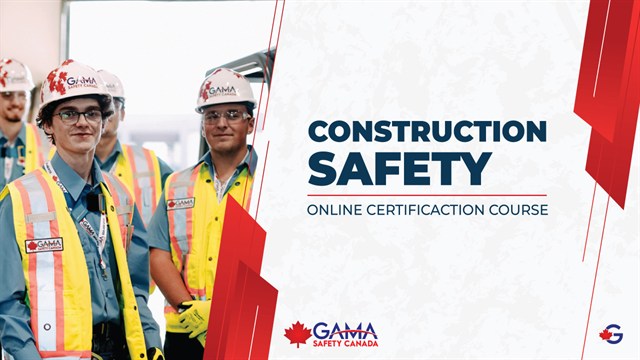
Construction safety training gives every worker on a job site the basic knowledge to spot hazards, use the right protection and know their rights and duties before they start work. It covers the most common site hazards, who is responsible for what, how to plan a job safely, and how to use PPE. This guide explains what it covers and how to take it online.
What is construction safety training?
Construction sites change every day. New trades arrive, equipment moves, and the building itself changes shape. That makes them some of the most dangerous workplaces in Canada. Every worker on site needs a solid base of safety knowledge before starting work.
Construction safety training is that base. It is general training, not tied to one machine or one task. It teaches you how to:
- Recognize common hazards on a job site
- Understand your rights and your duties
- Plan a task safely before it starts
- Follow site policies, safe work practices and written procedures
- Choose, wear and care for personal protective equipment (PPE)
It does not replace task-specific training. If you will work at heights, operate equipment or handle hazardous products, you need training for those too.
The most common construction hazards
Most serious injuries on construction sites come from a small group of hazards. Training teaches you to spot them early.
Falls
From roofs, scaffolds, ladders and openings, and slips and trips on the same level.
Struck-by
Moving equipment, vehicles, falling tools and materials.
Electrical
Contact with live wiring, damaged cords and overhead power lines.
Caught-between
Being pinned or crushed between equipment, materials or structures.
Debris
Poor housekeeping, scrap and building debris that cause trips and cuts.
Health hazards
Dust, noise, chemicals and older materials such as asbestos.
Knowing the hazard is the first step. The next step is using the right control, from good planning and housekeeping to guardrails and PPE.
Your rights and who is responsible for what
Every province and territory has its own occupational health and safety (OHS) law. The details differ, but the main ideas are the same across Canada. Workers have three basic rights:
- The right to know about hazards at work and how to protect yourself.
- The right to participate in health and safety, for example through a safety committee or representative.
- The right to refuse unsafe work that you believe puts you or others in danger, without being punished for it.
Everyone on site also has duties:
- Employers must provide a safe workplace, training, supervision and the right equipment.
- Supervisors must make sure workers know the hazards and follow safe procedures.
- Workers must follow the rules, use their PPE and report hazards and injuries.
- Contractors must work together so one trade’s work does not put another at risk.
Get your Construction Safety certificate today
100% online · unlimited free retakes · instant certificate + free wallet card
Pre-work planning and PPE
Many injuries can be stopped before the job starts. Pre-work planning means looking at the task, the site and the conditions first. Common tools include a hazard assessment, a toolbox talk with the crew, and checking equipment, weather and access before work begins.
PPE is the last line of defence, but on a construction site it is part of every shift. Basic site PPE includes:
- Hard hat
- High-visibility clothing
- Safety boots
- Gloves suited to the task
- Eye and hearing protection
Training teaches you how to choose, wear, inspect and care for each item, and when to replace it.
Some tasks need more than basic PPE, such as a respirator for dust, a face shield for grinding, or a full-body harness for work at heights. The hazard assessment tells you what is needed. If your PPE is damaged, does not fit or is missing, report it and do not start the task until it is fixed.
Who needs construction safety training?
Anyone who works on or visits an active construction site benefits from this training, including:
Please note: Gama Safety’s course is a general construction safety course. It is not the CSTS program. If your employer specifically asks for CSTS, take that program.
What the online course covers
Gama Safety’s Construction Safety course takes about 2.5 hours and has ten modules:
- Introduction to Construction Safety: why it matters and the most common hazards on Canadian job sites.
- Health and Safety: hazard awareness, reporting and your right to refuse unsafe work.
- Roles and Responsibilities: the duties of employers, supervisors, workers and contractors.
- Pre-work Planning: hazard assessments, toolbox talks and checking equipment and conditions.
- Policies: how site safety policies and rules work and what is expected of you.
- Personal Protective Equipment (PPE): choosing, wearing, inspecting and caring for your PPE.
- Building Debris and Foundation: controlling hazards from debris, housekeeping and foundation work.
- Safe Work Practices: everyday habits such as housekeeping, safe tool use and staying clear of moving equipment.
- Safe Work Procedures: how written procedures guide high-risk tasks step by step.
- Miscellaneous: other common hazards and key safety reminders.
Does construction safety training expire?
There is no single national expiry date for general construction safety training. It depends on your province and your employer. Many employers and contractors ask for a refresher every 1 to 3 years. You should also expect a site orientation each time you start on a new site, because every site has its own hazards and rules.
Refresh your training sooner if you move to a new type of work, after an incident or near miss on your site, or when your employer’s safety program changes. Construction safety is a base, not the finish line. Most workers add task-specific courses over time, such as fall protection, WHMIS, ladder safety or equipment training, depending on the work they do.
How to get your construction safety certificate online
- Enrol in the online Construction Safety course and start right away on your phone, tablet or computer.
- Learn at your own pace. Your progress saves automatically.
- Pass the final exam with 80% or better. Retakes are unlimited and free.
- Download your certificate right away. A physical wallet card is mailed to you free.
The course is available in English, French, Spanish, Punjabi, Hindi, Mandarin and more, and is recognized by employers across Canada. Training a crew? Volume pricing starts at 2 seats, with an admin dashboard to track progress.
Frequently asked questions
What is construction safety training?
It is general safety training for anyone who works on a construction site. It covers common hazards, worker rights, the duties of employers and supervisors, pre-work planning, PPE, and safe work practices and procedures.
Is this course the same as CSTS?
No. Gama Safety’s Construction Safety course is a general construction safety course. It is not the CSTS program. If your employer specifically asks for CSTS, take that program.
Can I take construction safety training online?
Yes. The course is 100% online and self-paced on any device. You will still get a site orientation from your employer when you start on a new site.
What are my three basic safety rights at work?
The right to know about hazards, the right to participate in health and safety, and the right to refuse unsafe work.
How long does the online construction safety course take?
About 2.5 hours. You can stop and continue anytime, and your progress saves automatically.
Does a construction safety certificate expire?
There is no single national expiry date. It depends on your province and employer, and many employers ask for a refresher every 1 to 3 years.
Related