
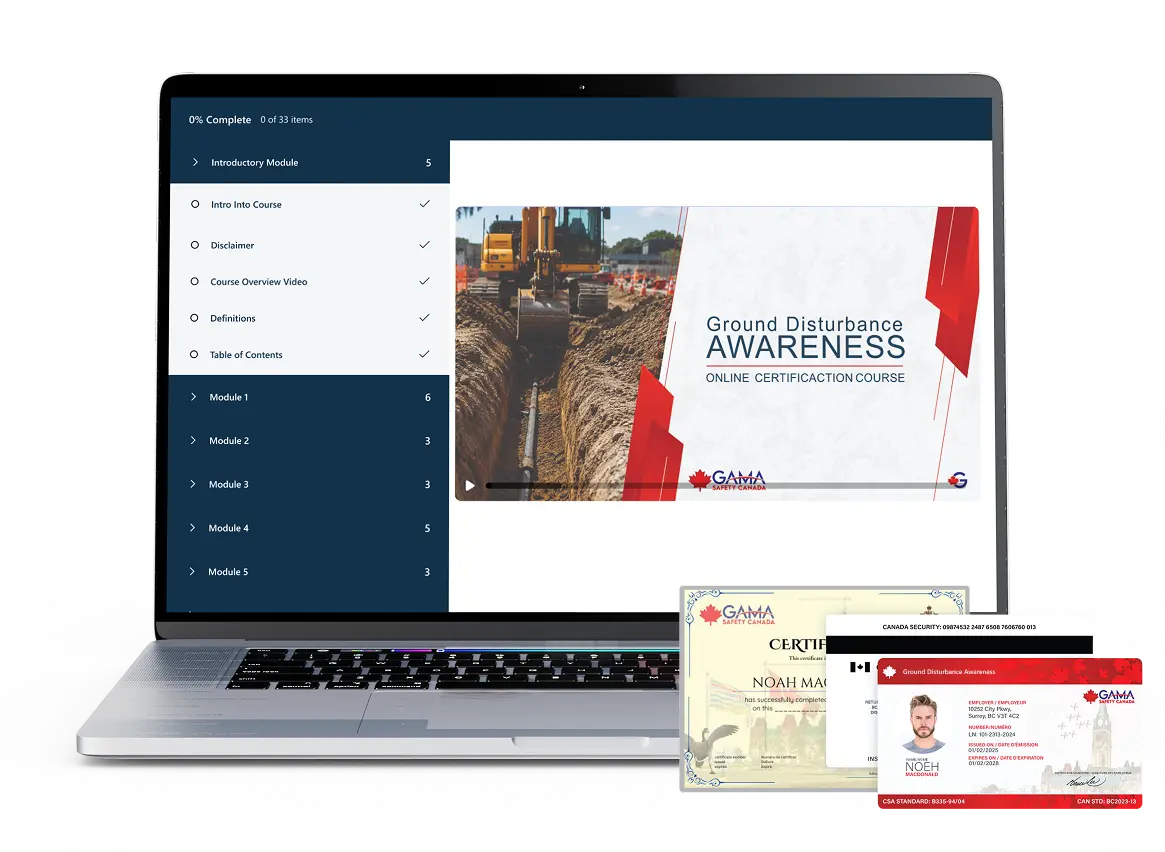
Ground disturbance is any work that breaks the ground surface or moves soil, such as digging, trenching, drilling, boring, grading or driving posts. It matters because gas lines, pipelines, power cables, water mains and fibre optic lines may be buried below. This guide explains the hazards, the safe ground disturbance process, who is responsible, and how to get Level 1 awareness training online.
What is ground disturbance?
Ground disturbance means any work, operation or activity that disturbs the earth. Common examples include:
Even small jobs count. A fence post, a sign, a tent stake or a landscaping bed can go deep enough to hit a buried line. You often cannot tell from the surface what is underneath, or how deep it is.
That is why ground disturbance follows a set process: find out what is buried, mark it, expose it carefully, and only then dig with machines.
What is buried, and why hitting it is dangerous
Gas and pipelines
Natural gas lines and high-pressure pipelines can leak, ignite or explode if damaged.
Power cables
Buried electrical lines can electrocute workers and burn equipment operators.
Water, sewer and fibre
Damage causes flooding, cave-ins, service outages and costly repairs.
Hitting a line can cause fires, explosions, electrocution, toxic gas release and outages for whole neighbourhoods. Even a small scrape or dent on a pipe can weaken it and fail later, so every contact must be reported, even if nothing seems wrong.
Ground disturbance sites have other hazards too, like trench cave-ins, moving equipment and traffic. Deep trenches may also need shoring or sloping to protect workers inside.
The ground disturbance process, step by step
- Plan the work. Define where and how deep you will dig, and review records and drawings for the area.
- Request locates. Contact your provincial one-call or locate service before you dig, and allow time for owners to respond. Private lines on the property may need a private locator.
- Mark and protect. Locators mark buried facilities on the ground. Keep the marks visible and do not dig until all owners have responded.
- Hand expose. Near a marked facility, expose it by hand digging or hydrovac, not with a machine bucket, until you can see it.
- Dig carefully. Use a spotter, keep clear of exposed lines, and support or protect them.
- Backfill and document. Backfill carefully around facilities, and record what was found and done.
The exact rules, such as how close machines may dig to a line, depend on the facility owner and your province.
Locates are not perfect. Marks show the approximate location of a line, not its exact position or depth. Lines can shift, records can be wrong, and some old or private lines are not on any map. That is why hand exposure matters, and why you should stop and ask if you find anything unexpected, such as warning tape, a line that is not marked, or a smell of gas.
Get your Ground Disturbance Awareness certificate today
100% online · unlimited free retakes · instant certificate + free wallet card
The rules and who is responsible
Ground disturbance is covered by provincial OHS regulations, and pipelines and utilities also have their own rules set by regulators and facility owners. The details vary across Canada, so your site plan and the facility owner’s requirements are your guide.
Responsibility is shared:
- Owners and prime contractors plan the work, arrange locates and make sure everyone is trained.
- Supervisors check that locates are valid, oversee hand exposure and sign off on the work.
- Workers follow the plan, respect the marks, stop work if something is unexpected, and report any contact right away.
Good records protect everyone. Keep copies of locate requests and responses, site drawings, crossing or proximity agreements where they apply, inspection notes and photos of exposed lines. If a question comes up later, these records show what was done and when.
Who needs ground disturbance training?
This Level 1 awareness course is for workers on or near a ground disturbance site:
Supervisors who plan and sign off on ground disturbance work usually need a supervisor-level course as well.
Facility owners and prime contractors often set their own training rules for anyone working on their sites or near their lines. Before you start a new job, ask which level of ground disturbance training is required and whether they accept online training.
What the online training covers
Gama Safety’s online Ground Disturbance Awareness course has four modules:
- Ground Disturbance & Damage Prevention: what counts as ground disturbance, what buried facilities may be present, and the basics of preventing damage.
- The Ground Disturbance Process & Worker Safety: the steps from planning and locates to hand exposure and backfill, and how to stay safe on site.
- Responsibilities & Accountability: the roles of owners, prime contractors, supervisors and workers, and who is accountable at each step.
- On the Job: Inspection, Documentation & Emergency Response: site inspections, the records to keep, and what to do right away if a line is hit.
If you hit a line: stop work, shut down equipment if it is safe to do so, move people away and upwind, keep ignition sources away, call 911 if there is a gas leak, fire or injury, and notify the facility owner and your supervisor.
Does ground disturbance training expire?
There is no single national expiry date. It depends on your province, the facility owners you work around and your employer. Many employers ask for a refresher every 1 to 3 years.
How to get certified online with Gama
- Enrol in the online Ground Disturbance Awareness course and start right away on any device.
- Learn at your own pace. The course takes about 2 hours, and your progress saves automatically.
- Pass the final exam with 80% or better. Retakes are unlimited and free.
- Download your certificate right away. A physical wallet card is mailed to you free.
The course is WorkSafe-aligned, recognized by employers across Canada, and available in English, French, Spanish, Punjabi, Hindi, Mandarin and more. Team pricing starts at 2 seats. Call 1-866-661-9803 or email info@gamasafety.ca.
Frequently asked questions
What is considered ground disturbance?
Any work that breaks the ground surface or moves soil, such as digging, trenching, drilling, boring, augering, grading or driving posts. Even small jobs like installing a fence post can count.
Who needs ground disturbance Level 1 training?
Workers on or near a ground disturbance site, such as labourers, equipment operators, spotters, utility and pipeline crews, landscapers and construction crews. Supervisors usually need a supervisor-level course as well.
Can I take ground disturbance training online?
Yes. Gama Safety’s Ground Disturbance Awareness (Level 1) course is 100% online, and you can download your certificate as soon as you pass.
What should I do if I hit an underground line?
Stop work, shut down equipment if safe, move everyone away, keep ignition sources away, and call 911 if there is a gas leak, fire or injury. Then notify the facility owner and your supervisor. Report every contact, even a small scrape.
What is hand exposure?
Hand exposure means uncovering a buried facility by careful hand digging or hydrovac, instead of a machine bucket, so you can see exactly where it is before digging nearby.
Does ground disturbance certification expire?
There is no single national expiry date. It depends on your province, the facility owners and your employer. Many employers ask for refreshers every 1 to 3 years.
Related