
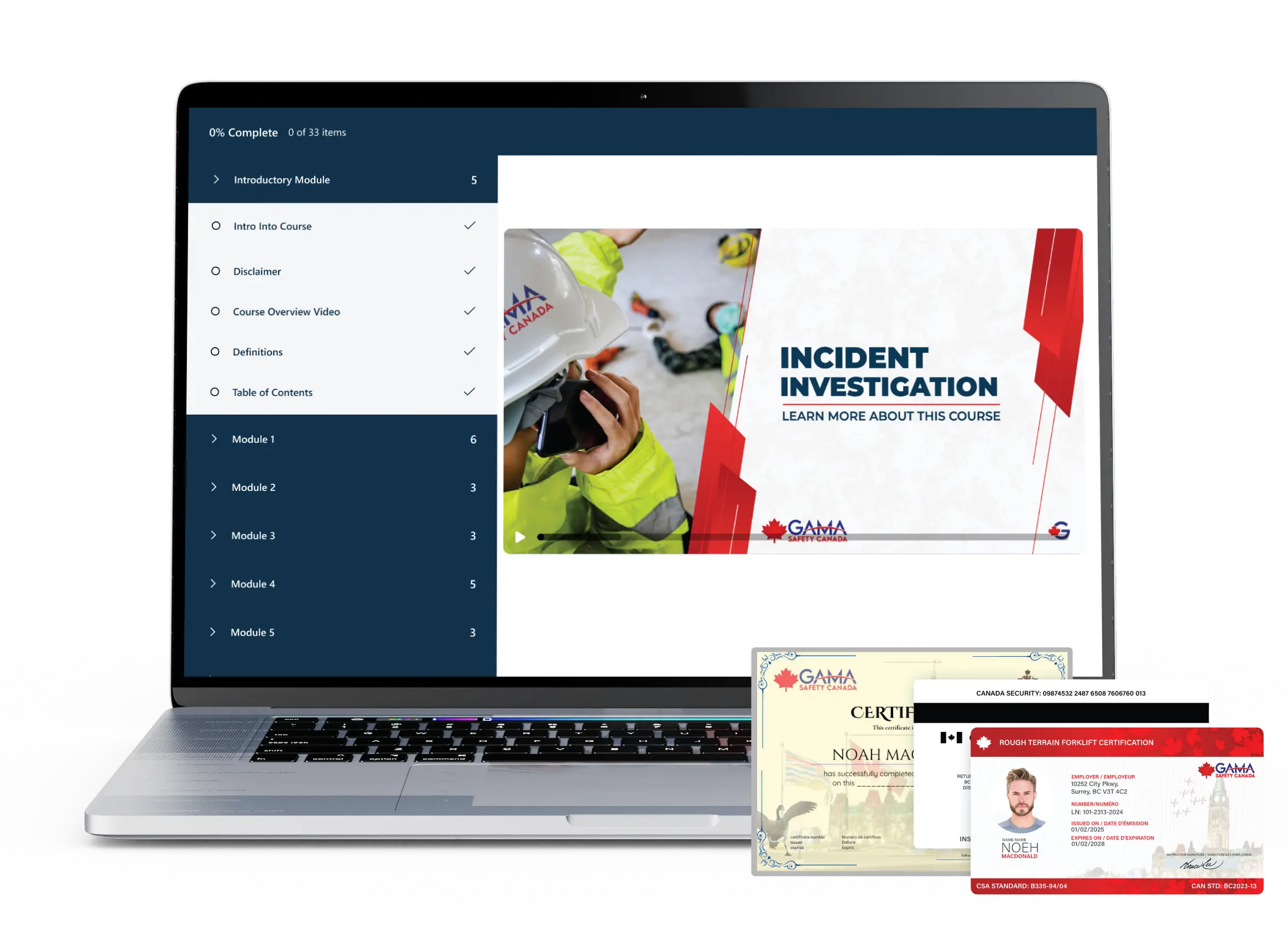
An incident investigation is a step-by-step look at what happened at work, why it happened, and what must change so it does not happen again. It covers everything from near misses to serious injuries. This guide explains the steps of a good investigation, how to find root causes, who should be trained, and how to get certified online.
What is incident investigation?
An incident is any unplanned event at work that causes, or could have caused, injury, illness or damage. An incident investigation is the process of gathering the facts about that event, working out why it happened, and fixing the causes.
The goal is prevention, not blame. Many investigations stop at “the worker was careless” or “human error.” That answer does not fix anything. A good investigation asks why the error was possible. Was the task rushed? Was the guard missing? Was the training unclear? Those deeper answers are the root causes, and fixing them protects the next worker.
Every incident is a warning. A near miss today can be a serious injury next month if nothing changes. Investigating small events is one of the cheapest ways to stop big ones.
Types of incidents you should investigate
1. Near misses
Nobody was hurt and nothing broke, but it could have. These are free lessons.
2. Injuries and illness
From first aid cases to serious injuries that need medical care or time off work.
3. Damage and releases
Equipment or property damage, spills, leaks, fires and other dangerous events.
The size of the investigation can match the risk. A small near miss may only need a short review by the supervisor. A serious injury needs a full investigation with evidence, interviews, a written report and follow-up.
The steps of an incident investigation
- Respond right away. Get first aid or emergency help for anyone hurt, and make the area safe so no one else is injured.
- Secure the scene. Keep people out and leave things where they are, unless moving them is needed to save a life or stop more harm.
- Gather evidence. Take photos, sketch the area, take measurements, and collect records such as training files, inspection logs and work orders.
- Interview witnesses. Talk to each person on their own, as soon as you can. Ask open questions and listen. Do not lead or blame.
- Find the causes. Separate the immediate cause (what directly led to the event) from the root causes (why it was possible).
- Write the report. Describe what happened, the causes, and the corrective actions, in clear and simple words.
- Fix and follow up. Assign each action to a person with a due date, share what you learned, and check later that the fix worked.
Get your Incident Investigation certificate today
100% online · unlimited free retakes · instant certificate + free wallet card
Root cause analysis: the 5 Whys and fishbone diagrams
The 5 Whys is a simple tool. Start with the problem and keep asking “why?” until you reach a cause you can fix. For example: a worker slipped. Why? There was oil on the floor. Why? A machine was leaking. Why? The seal was worn. Why? It was not on the maintenance schedule. Why? There was no schedule for that machine. Now you have a real fix: set up a maintenance schedule, not just mop the floor.
A fishbone diagram (also called a cause-and-effect diagram) helps a team think about all the possible causes at once. The problem goes at the “head” of the fish. Each “bone” is a group of causes, such as:
Most incidents have more than one cause. Good tools help you see all of them so your fixes are complete, and they keep the team focused on facts instead of opinions.
What the law says, in plain words
In Canada, workplace health and safety is mostly set by each province and territory, with federal rules for federally regulated workplaces. Across the country, provincial OHS regulations require employers to investigate incidents and to report serious ones to the regulator. The exact rules change from place to place, including:
- which incidents must be investigated and reported,
- how fast the report must be made,
- who must take part, such as a worker representative or a Joint Health and Safety Committee member,
- and when the scene must be left untouched for an inspector.
Check the rules for your province and your own company procedure. The skills in this course, such as securing the scene, collecting facts and finding root causes, apply everywhere.
Who needs incident investigation training?
Anyone who may be asked to look into an incident at work. This often includes:
Workers also benefit. Knowing how investigations work makes it easier to report near misses and give clear witness statements.
What the online course covers
The Gama Safety Incident Investigation course has three parts and takes about one hour:
- Part I: types of incidents, why investigations and reporting matter, and how to respond, secure the scene and preserve evidence.
- Part II: gathering evidence, interviewing witnesses, and using root cause tools like the 5 Whys and fishbone diagrams to tell immediate causes from root causes.
- Part III: writing a clear investigation report, setting corrective actions, sharing findings and following up to prevent repeat incidents.
There is no single national expiry date for this training. It depends on your province and your employer. Many employers ask for a refresher every 1 to 3 years, or after a change in role.
How to get certified online with Gama Safety
- Enrol in the online Incident Investigation course and start right away on your phone, tablet or computer.
- Learn at your own pace. Your progress saves automatically, so you can stop and come back anytime.
- Pass the final exam with 80% or better. Retakes are unlimited and free.
- Download your certificate right away. A physical wallet card is mailed to you free.
The course is available in English, French, Spanish, Punjabi, Hindi, Mandarin and more, and is recognized by employers across Canada. Training a team? Volume pricing starts at 2 seats, with an admin dashboard to track progress. Questions? Call 1-866-661-9803 or email info@gamasafety.ca.
Frequently asked questions
What is the main purpose of an incident investigation?
To find out why an incident happened and fix the root causes so it does not happen again. The purpose is prevention, not finding someone to blame.
Do near misses need to be investigated?
Yes, they should be. A near miss shows a hazard before anyone is hurt. Many company procedures and provincial OHS rules expect near misses to be reported and looked into.
What is the difference between an immediate cause and a root cause?
The immediate cause is what directly led to the incident, like oil on the floor. The root cause is the deeper reason it was possible, like no maintenance schedule for the leaking machine.
Who should do an incident investigation?
Usually a supervisor or manager, often with a worker representative or Joint Health and Safety Committee member. The exact rules depend on your province and your company procedure.
How long does the online incident investigation course take?
About one hour. It is self-paced, so you can stop and continue anytime, and you can download your certificate as soon as you pass.
Does an incident investigation certificate expire?
There is no fixed national expiry. It depends on your province and employer. Many employers ask for a refresher every 1 to 3 years.
Related