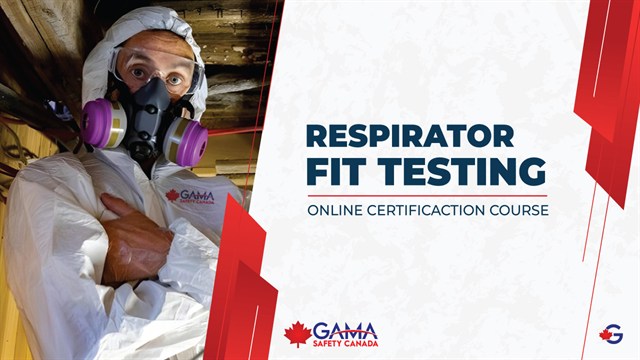
Respirator fit testing is a test that checks whether a tight-fitting respirator seals properly to your face, so contaminated air cannot leak in around the edges. It is done in person, on the exact make, model and size of respirator you will wear. This guide explains how fit testing works, who needs it, when to repeat it, and how to learn the theory online.
What is respirator fit testing?
A respirator only protects you if two things are true. It must be the right type for the hazard, and it must seal properly to your face. Faces come in many shapes and sizes, so one model that fits a co-worker well may leak on you.
A fit test is how you find out. A trained fit tester has you wear the respirator and do a set of movements, like breathing deeply, turning your head and talking, while they check whether air leaks in around the seal. If it passes, you know that make, model and size works for you.
Fit testing applies to tight-fitting respirators, such as disposable N95-type masks, half-face and full-face respirators. Loose-fitting hoods and helmets used with some powered air units do not seal to the face in the same way.
Qualitative vs quantitative fit testing
There are two main ways to run a fit test:
Qualitative
A pass or fail test. A test agent is sprayed around you. If you can taste or smell it, the respirator is leaking.
Quantitative
A machine measures how much leaks in and gives a number called a fit factor. Often used for full-face respirators.
Seal check (not a fit test)
A quick check you do yourself each time you put the respirator on. It does not replace a fit test.
Which method is used depends on the respirator type and the rules that apply at your workplace. Both must be done in person by a competent fit tester.
The rules in plain words
Provincial OHS regulations require employers to protect workers from airborne hazards. When other controls, like ventilation or using a safer product, cannot remove the risk, respirators are used. In that case, employers are generally expected to run a respiratory protection program.
In Canada, the main standard for respirators is CSA Z94.4, Selection, use and care of respirators, and provincial rules often refer to it. A typical program includes:
- Assessing the hazard and choosing the right respirator.
- Training workers on use, limits and care.
- Fit testing workers who wear tight-fitting respirators.
- Health checks where needed, plus maintenance, storage and records.
The exact rules, including how often fit tests must be repeated, differ by province. Your employer’s program should spell them out.
Get your Respirator Fit Testing certificate today
100% online · unlimited free retakes · instant certificate + free wallet card
Who needs fit testing and respirator training?
Anyone who wears a tight-fitting respirator at work, and the people who run the program. Common jobs include:
Workers exposed to dusts such as silica or asbestos, chemical vapours, fumes, or germs in healthcare settings are the most common groups.
Facial hair matters. Beards and stubble where the respirator meets the skin can stop it from sealing. Most programs require you to be clean-shaven in the seal area for a tight-fitting respirator.
What the online training covers
Gama Safety’s online Respirator Fit Testing course has eight modules:
- Introduction to Respiratory Protection: airborne hazards and why respirators are needed when other controls cannot remove the risk.
- Respirator Types and Selection: disposable, half-face, full-face, powered and supplied-air respirators, and how to choose.
- Respirator Use and Limitations: putting on, seal checking and wearing a respirator, and what it cannot protect you from.
- Fit Testing Methods: qualitative and quantitative testing, and when a new test is needed.
- Fit Test Administration: the steps of a fit test, from preparation and exercises to recording results and handling a fail.
- Respirator Maintenance and Care: inspecting, cleaning, storing and replacing respirators, filters and cartridges.
- Health Surveillance and Medical Evaluations: why some workers need a medical check before wearing a respirator.
- Incident Reporting and Record Keeping: the records a program keeps and how to report problems and failures.
Online theory vs the actual fit test
This online course is the theory part. An actual fit test cannot be done online. It must be done in person by a competent fit tester, on the exact make, model and size of respirator you will wear. Your employer arranges the fit test with a qualified fit tester.
Think of it this way: the course teaches you why fit matters, how a test works and how to look after your respirator. The fit test proves that your respirator fits your face.
Doing the theory first also makes the fit test go more smoothly. You will already know how to put the respirator on, adjust the straps, do a seal check, and what the test exercises are for. Supervisors and safety staff who run a respiratory protection program get a clear picture of the records and follow-up the program needs.
When do you need a new fit test?
In BC, workers who wear a tight-fitting respirator must be fit tested before first use and at least once a year, following CSA Standard Z94.4. Rules in other provinces vary. You should also get a new fit test when:
- You switch to a different make, model or size of respirator.
- Your face changes, for example from major weight change, dental work or facial surgery.
- The respirator no longer feels like it seals, or you fail a seal check.
The training certificate itself does not have one national expiry date. Many employers ask for a refresher every 1 to 3 years.
How to take the training online with Gama
- Enrol in the online Respirator Fit Testing course and start right away on any device.
- Learn at your own pace. The course takes about 2.5 hours, and your progress saves automatically.
- Pass the final exam with 80% or better. Retakes are unlimited and free. Download your certificate right away, and get a wallet card mailed free.
- Get your in-person fit test through your employer, with a qualified fit tester, on the respirator you will wear.
The course is available in English, French, Spanish, Punjabi, Hindi, Mandarin and more, and it is recognized by employers across Canada. Team pricing starts at 2 seats. Call 1-866-661-9803 or email info@gamasafety.ca.
Frequently asked questions
What is a respirator fit test?
A respirator fit test checks whether a tight-fitting respirator seals properly to your face. It is done in person, on the exact make, model and size of respirator you will wear.
Can respirator fit testing be done online?
No. The theory can be learned online, but the actual fit test must be done in person by a competent fit tester. Your employer arranges it.
What is the difference between qualitative and quantitative fit testing?
Qualitative fit testing is a pass or fail test based on whether you can taste or smell a test agent. Quantitative fit testing uses a machine to measure leakage and gives a number called a fit factor.
How often do I need a respirator fit test?
In BC, at least once a year and before you first use a tight-fitting respirator. Rules in other provinces vary. You also need a new test if you change respirator model or size, or if your face changes.
Can I wear a respirator with a beard?
Facial hair where a tight-fitting respirator meets the skin can stop it from sealing. Most programs require you to be clean-shaven in the seal area. Loose-fitting powered hoods may be an option; ask your employer.
Is a seal check the same as a fit test?
No. A seal check is a quick check you do each time you put on the respirator. A fit test is a formal test done by a fit tester to confirm the model and size fit your face.
Related