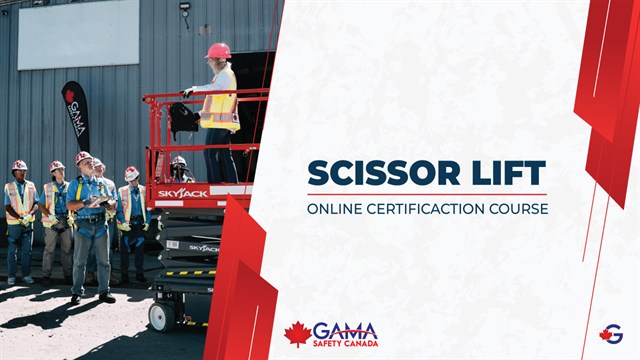
Scissor lift certification means you have completed operator training, theory plus a hands-on practical evaluation, and been familiarized with the machine you will use. There is no government scissor lift licence in Canada. This guide explains the hazards, the standards in plain words, what training covers, and how to start with the theory online.
What is a scissor lift?
A scissor lift is a mobile elevating work platform (MEWP) that raises workers, tools and materials straight up on a set of folding, crossed arms. It does not reach out sideways like a boom lift. Scissor lifts are common in warehouses, construction, retail, facilities and maintenance work.
You will hear a few names for the same family of machines:
- Elevating work platform (EWP): the general term for a platform that lifts workers.
- MEWP: the term used in the newer CSA standards. It covers scissor lifts and boom lifts.
- Scissor lift: a platform that only goes up and down.
- Boom lift or aerial lift: a platform on an arm that reaches up and out.
Training for one type does not automatically cover another. A scissor lift and a boom lift handle very differently.
The main scissor lift hazards
Scissor lifts look stable, but they can tip, pinch and fall. Training focuses on the main dangers:
Tip-overs
Overloading, driving while raised on uneven ground, slopes, holes and wind.
Falls and crushing
Leaning over or climbing guardrails, and getting pinned against a ceiling or beam.
Power lines
Raising the platform into or near overhead electrical lines.
Each one is preventable with a good pre-use inspection, a check of the work area, respect for the load limit, and knowing the emergency controls.
Do you need a licence to drive a scissor lift?
No. There is no government scissor lift licence in Canada. What you need is operator training and a practical evaluation, and your employer must make sure you are competent before you use the lift.
Here is how the rules work in plain words:
- Provincial OHS regulations require employers to make sure workers are trained for the equipment they use. In BC, for example, WorkSafeBC’s OHS Regulation (section 13.2) says a work platform must meet, and be used according to, the CSA or ANSI standard in effect when it was made.
- In Canada, MEWPs are covered by the CSA B354 standards. Newer machines fall under the MEWP series: B354.6 (design), B354.7 (safe use, inspection, maintenance and operation) and B354.8 (operator training). Older machines were built to earlier standards such as B354.2 for self-propelled platforms.
- Training must include theory and a practical evaluation by a qualified person.
- You also need familiarization on the actual machine: the controls, emergency lowering, safety devices and the manufacturer’s limits.
Important: an online course is the theory part only. It does not qualify you to operate a scissor lift on its own. You must also pass a hands-on practical evaluation on the machine.
Get your Scissor Lift certificate today
100% online · unlimited free retakes · instant certificate + free wallet card
Who needs scissor lift training?
Anyone who operates a scissor lift or works from its platform. Common jobs include:
The online course is for new operators getting ready for a practical evaluation, experienced operators who need a refresher, and supervisors who oversee lift work.
Keep in mind that training is tied to the type of machine. If you have only been trained on a scissor lift, you are not trained on a boom lift. And when you move to a scissor lift model you have not used before, your employer should give you upgrade training or familiarization so you can show you can operate it safely.
What scissor lift theory training covers
The Gama online Scissor Lift course has eight modules:
- Introduction to scissor lifts: parts, types and where they are used.
- Pre-operational inspection: checking the lift, controls, guardrails and work area before each shift.
- Safe operation procedures: driving, raising and lowering the platform, and working at height.
- Stability and load capacity: load limits, slopes, wind and ground conditions.
- Working with power lines: the dangers and how to keep a safe distance.
- Emergency procedures: what to do if the lift fails or tips, and emergency lowering.
- Maintenance and servicing: basic care, battery charging and reporting defects.
- Practical training and assessment: what the hands-on evaluation involves and how to prepare.
Do you need a harness on a scissor lift?
Scissor lifts generally rely on their guardrails as the main fall protection. Keep the gate or chain closed, stand on the platform floor, and never climb or sit on the rails. Some employers, sites or manufacturers also require a harness and lanyard attached to an approved anchor point. Always follow the manufacturer’s manual and your site rules.
Online theory vs hands-on training
The online course teaches the knowledge part. The practical evaluation and familiarization must be done on real equipment, usually by your employer or a qualified evaluator.
Gama Safety Canada also offers hands-on scissor lift training at our training centre in Burnaby, BC, or on site at your workplace.
Does scissor lift certification expire? According to WorkSafeBC’s guidelines, the applicable standards do not set a fixed retraining interval. Retraining is needed when problems with an operator’s skills are found, or when you move to equipment you are not familiar with. Many employers set their own refresher schedule, often every 1 to 3 years.
How to start scissor lift certification online
- Enrol in the online Scissor Lift course and start right away on your phone, tablet or computer.
- Learn at your own pace. The course takes about 3.5 hours, and your progress saves automatically.
- Pass the final exam with 80% or better. Retakes are unlimited and free. Download your certificate right away, and get a wallet card mailed free.
- Complete your practical evaluation on the scissor lift with your employer, a qualified evaluator, or Gama’s hands-on training.
The course is recognized by employers across Canada and available in English, French, Spanish, Punjabi, Hindi, Mandarin and more. Training a team? Volume pricing starts at 2 seats, with an admin dashboard. Questions? Call 1-866-661-9803 or email info@gamasafety.ca.
Frequently asked questions
Do you need a licence to drive a scissor lift?
No. There is no government licence in Canada. You need operator training to the applicable standard, a practical evaluation, and familiarization on the machine you will use.
Can I get scissor lift certified online?
You can do the theory online. You still need a hands-on practical evaluation and familiarization on the specific machine before you operate it at work.
How long is scissor lift certification valid?
There is no fixed national expiry date, and the applicable standards do not set a fixed retraining interval. Retraining is needed when skill problems are found or you use unfamiliar equipment, and many employers set their own refresher schedule.
Does scissor lift training cover boom lifts?
No. Boom lifts handle differently and need their own training and familiarization.
What is CSA B354.8?
CSA B354.8 is the Canadian standard for MEWP operator training. It sets out how operator training should be prepared and delivered.
Do you need a harness on a scissor lift?
Scissor lifts generally rely on guardrails for fall protection. Some sites and manufacturers also require a harness, so follow the manual and your site rules.
Related