
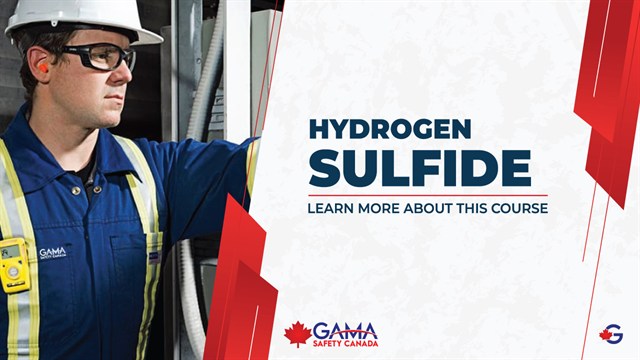
H2S, or hydrogen sulfide, is a toxic and flammable gas that smells like rotten eggs and can be fatal if you breathe it in. It is also called sour gas or sewer gas. This guide explains where H2S is found, why you cannot trust your nose, how workers stay safe, and the difference between H2S awareness training and H2S Alive.
What is hydrogen sulfide (H2S)?
Hydrogen sulfide is a colourless gas. It forms when organic matter, such as sewage, manure or plant material, breaks down without oxygen. It also occurs naturally in crude oil and natural gas, which is why the oil and gas industry calls it sour gas.
Three facts make H2S especially dangerous at work:
Toxic
It can be fatal if inhaled, and high levels can cause sudden collapse.
Flammable
It is extremely flammable and can catch fire or explode.
Heavier than air
It collects in low areas like pits, tanks, sewers and other confined spaces.
At low levels, H2S has a strong rotten-egg smell. But at higher levels it can quickly deaden your sense of smell. If the smell goes away, it does not mean the gas is gone. It may mean the level is high enough to be dangerous. That is why workers rely on gas detectors, not their nose.
Where do workers find H2S?
H2S can build up anywhere organic material rots in a closed or low space, and in many industrial processes. Common workplaces include:
Pits, tanks, vaults, wells, sumps, manholes and other confined spaces are the highest-risk spots, because the gas sinks and builds up with little air movement. Disturbing sludge or liquid, for example by pumping or agitating it, can release a lot of gas very quickly.
How H2S affects your health
H2S harms the body in different ways depending on how much is in the air and for how long you breathe it.
- Lower levels can irritate the eyes, nose and throat, and cause headache, nausea, dizziness and coughing.
- Higher levels can knock out your sense of smell, affect your breathing, and cause confusion and loss of balance.
- Very high levels can cause a worker to collapse suddenly, stop breathing and die.
Many H2S deaths involve more than one person. A worker collapses in a pit or tank, and a co-worker climbs in to help and is overcome too. Never enter to rescue someone unless you are trained, equipped with the right breathing apparatus, and part of a rescue plan. Get out, raise the alarm and call for trained help.
Get your Hydrogen Sulfide certificate today
100% online · unlimited free retakes · instant certificate + free wallet card
How workers stay safe around H2S
Employers must assess H2S hazards and put controls in place under provincial OHS regulations. Common controls include:
- Gas detection: personal gas monitors, plus air testing before and during work in areas where H2S may be present.
- Ventilation: bringing in fresh air and removing contaminated air.
- Safe work procedures: confined space entry permits, isolation, and a plan for what to do if an alarm sounds.
- Respiratory protection and PPE: the right respirator for the hazard, fit tested and used by trained workers.
- Emergency plans: knowing your escape route, going upwind and to higher ground, and how to call for help.
Workers have a part to play too. Wear your gas monitor where it can sample the air you breathe, bump test or check it as your employer requires, and never ignore an alarm. If your monitor alarms, stop work and leave the area right away. Do not go back in until the area has been tested and declared safe by someone trained to do it.
H2S Alive vs H2S awareness training
These two are often confused, and they are not the same.
- H2S Alive® is a specific one-day course from Energy Safety Canada, delivered by Energy Safety Canada or its approved providers. It includes hands-on practice, such as rescue drags and putting on and taking off a self-contained breathing apparatus (SCBA). Energy Safety Canada says the certificate is valid for three years.
- H2S awareness is a general term for knowledge-based training: what H2S is, where it is found, health effects, detection, controls and how to respond in an emergency. It does not include hands-on breathing apparatus or rescue practice.
Many oil and gas employers require H2S Alive by name. If your employer or site asks for H2S Alive, an awareness course will not replace it. Gama Safety does not offer H2S Alive, and our course is not affiliated with Energy Safety Canada. Our online course is awareness-level training for general industry. Always check which course your employer accepts before you enrol.
What the online H2S course covers
The Gama Hydrogen Sulfide course is for workers in wastewater, sewer maintenance, pulp and paper, landfills, agriculture, food processing and confined space work, and for their supervisors. It has six modules:
- Introduction to hydrogen sulfide: properties and where it is found
- Health hazards of H2S and the signs of exposure
- Assessing H2S hazards with gas detectors and air monitoring
- Preventive measures: ventilation, safe work procedures, respiratory protection and PPE
- Emergency response and rescue, and why untrained rescuers must not go in
- Case studies and incident reviews
Does it expire? There is no single national expiry date for H2S awareness training. It depends on your province and employer, and many employers ask for a refresher every 1 to 3 years.
How to get H2S awareness training online
- Enrol in the online Hydrogen Sulfide course and start right away on your phone, tablet or computer.
- Learn at your own pace. The course takes about 1.5 hours, and your progress saves automatically.
- Pass the final exam with 80% or better. Retakes are unlimited and free.
- Download your certificate right away. A physical wallet card is mailed to you free.
The course is recognized by employers across Canada and available in English, French, Spanish, Punjabi, Hindi, Mandarin and more. Training a team? Volume pricing starts at 2 seats, with an admin dashboard. Questions? Call 1-866-661-9803 or email info@gamasafety.ca.
Frequently asked questions
What is H2S?
H2S is hydrogen sulfide, a colourless, toxic and extremely flammable gas that smells like rotten eggs. It is also called sour gas or sewer gas and can be fatal if inhaled.
Why can’t you rely on the smell of H2S?
At higher levels, H2S can quickly deaden your sense of smell. If the smell disappears, the gas may still be there at a dangerous level, so workers use gas detectors instead.
Where is H2S found at work?
In sewers, wastewater plants, manure pits, landfills, pulp and paper mills, oil and gas sites, food processing and confined spaces such as pits, tanks and vaults.
Is H2S Alive the same as H2S awareness?
No. H2S Alive is Energy Safety Canada’s one-day course with hands-on rescue and breathing apparatus practice. Awareness courses teach knowledge only.
Does Gama Safety offer H2S Alive?
No. Gama’s online Hydrogen Sulfide course is awareness training. For H2S Alive, contact Energy Safety Canada or one of its approved training providers.
How long does the online H2S course take?
About 1.5 hours. It is self-paced, and you can download your certificate as soon as you pass the final exam with 80% or more.
Related