
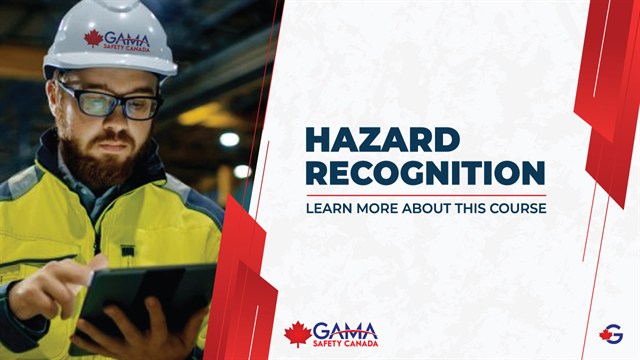
Hazard recognition is the skill of spotting anything at work that could hurt someone, before an injury happens. It is the first step in every safety program, because you cannot control a hazard nobody has noticed. This guide explains the types of hazards, the tools used to find them, how to decide what to fix first, and how to get hazard recognition training online.
What is hazard recognition?
A hazard is anything that could cause harm: a condition (a wet floor), an action (lifting a heavy box the wrong way), or a material (a chemical that burns skin). Risk is how likely it is that the hazard will actually hurt someone, and how bad the harm could be.
Hazard recognition means training your eyes to see these things before work starts and while it is going on. Workers who can recognize hazards can avoid them, report them, and help put the right controls in place. Supervisors use the same skill to plan safe work and check that controls are working.
Hazard recognition is not a one-time task. Jobs change, sites change, crews change and weather changes. Good workers look for hazards every day, not only when there is an inspection.
The 5 types of workplace hazards
Most hazards fall into one of five groups. Knowing the groups helps you look in the right places.
Physical
Moving machinery, falls, noise, electricity, heat, cold and vibration.
Chemical
Liquids, gases, vapours, dusts and fumes that can burn, poison or catch fire.
Biological
Bacteria, viruses, mould, blood and body fluids, and animal or insect bites.
Ergonomic
Heavy lifting, awkward postures and repetitive motions that strain muscles and joints.
Psychosocial
Stress, fatigue, harassment, violence and long or lone work shifts.
Some hazards fit more than one group. For example, a dusty work area can be both a chemical hazard (what the dust is made of) and a physical one (poor visibility). What matters is that you notice it.
How to find hazards: inspections, JHA and FLHA
Workplaces use a few standard tools to find hazards in a planned way:
- Workplace inspections: a walk-through of an area with a checklist, looking at equipment, housekeeping, exits, storage and work practices.
- Job hazard analysis (JHA): break a job into steps, list the hazards in each step, and write down the controls for each one. A JHA is usually done for regular or high-risk tasks.
- Field level hazard assessment (FLHA): a short check done by the crew at the work location, before the job starts and whenever conditions change. It catches the hazards of today: weather, other trades nearby, new equipment.
- Reports from workers: hazard reports, near-miss reports and safety committee feedback.
A simple habit helps on every job: stop, look, think, then act. Before you start, look up, down and all around. Ask what could go wrong, who could be hurt, and what would stop it.
Get your Hazard Recognition certificate today
100% online · unlimited free retakes · instant certificate + free wallet card
Risk assessment: what to fix first
You will often find more than one hazard. Risk assessment helps you decide which ones to deal with first. The usual method rates each hazard on two things:
- Likelihood: how likely is it that someone will be hurt?
- Severity: if it happens, how bad could the harm be?
A hazard that is both likely and severe is high risk and must be controlled before work goes ahead. A hazard that is unlikely and minor is lower risk, but still needs attention. Many workplaces use a simple risk matrix to score this.
Risk is not fixed. A job that was low risk yesterday can be high risk today if it rains, a new crew arrives, or a piece of equipment changes. That is why the assessment should be repeated whenever conditions change, and why every worker has a part to play by reporting what they see.
The hierarchy of controls
Once you know the hazard and the risk, you pick a control. The hierarchy of controls ranks controls from most to least effective:
- Elimination: remove the hazard completely.
- Substitution: replace it with something less dangerous, such as a safer chemical.
- Engineering controls: change the equipment or workplace, such as guards, ventilation or barriers.
- Administrative controls: change the way people work, such as procedures, training, signs and job rotation.
- Personal protective equipment (PPE): gloves, eye protection, hearing protection, respirators and more.
PPE is the last line of defence, not the first. It only works if it fits, is worn correctly and is in good condition. The best plans use controls from the top of the list and add PPE for what is left.
Who needs hazard recognition training?
Everyone at work benefits from hazard recognition skills, and it is common in onboarding for new staff. The course is used in many jobs, including:
Under provincial OHS regulations, employers have a general duty to identify hazards, control them and train workers. Supervisors must make sure workers know about the hazards in their work. Workers must follow safe work practices and report hazards they find.
What the online course covers
The Gama Hazard Recognition course has nine modules:
- Introduction to hazard recognition and the roles of workers and supervisors
- Types of workplace hazards, with examples
- Hazard identification methods: inspections, JHA and FLHA
- Risk assessment and analysis
- Hazard control measures and the hierarchy of controls
- Hazard communication and training
- Incident reporting and investigation, including near misses
- Continuous improvement as jobs and sites change
- Case studies and practical applications
Does it expire? There is no single national expiry date. It depends on your province and employer, and many employers ask for a refresher every 1 to 3 years.
How to get hazard recognition training online
- Enrol in the online Hazard Recognition course and start right away on your phone, tablet or computer.
- Learn at your own pace. The course takes about 1.5 hours, and your progress saves automatically.
- Pass the final exam with 80% or better. Retakes are unlimited and free.
- Download your certificate right away. A physical wallet card is mailed to you free.
The course is WorkSafe-aligned, recognized by employers across Canada, and available in English, French, Spanish, Punjabi, Hindi, Mandarin and more. Training a team? Volume pricing starts at 2 seats, with an admin dashboard to track progress. Questions? Call 1-866-661-9803 or email info@gamasafety.ca.
Frequently asked questions
What is hazard recognition?
Hazard recognition is the skill of spotting conditions, actions or materials at work that could hurt someone, before an injury happens. It is the first step in controlling any hazard.
What are the 5 types of workplace hazards?
The five common groups are physical, chemical, biological, ergonomic and psychosocial hazards.
What is the difference between a hazard and a risk?
A hazard is anything that could cause harm. Risk is how likely it is that the hazard will hurt someone and how serious the harm could be.
What is an FLHA?
An FLHA, or field level hazard assessment, is a short hazard check done by the crew at the work location before a job starts and whenever conditions change.
What is the hierarchy of controls?
It ranks hazard controls from most to least effective: elimination, substitution, engineering controls, administrative controls, and personal protective equipment.
How long does the online Hazard Recognition course take?
About 1.5 hours. It is self-paced, and you can download your certificate as soon as you pass the final exam with 80% or more.
Related