
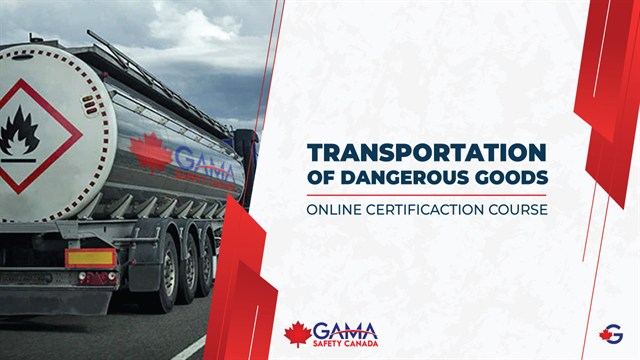
TDG stands for Transportation of Dangerous Goods, the federal rules that control how dangerous goods are handled, offered for transport and transported in Canada. Anyone who does these tasks must be trained and hold a valid TDG training certificate, or work under the direct supervision of someone who does. This guide explains the nine classes, the training rules, who issues your certificate and how long it lasts.
What is TDG?
Dangerous goods are products, substances or organisms that can harm people, property or the environment if they are released while being moved. Examples include fuels, propane, paints, batteries, compressed gases, acids, pesticides and some medical samples.
In Canada, moving these goods is controlled by the Transportation of Dangerous Goods Act and the Transportation of Dangerous Goods Regulations, run by Transport Canada. Because the rules are federal, they apply across the country. They set out how dangerous goods must be classified, packed, marked, labelled, placarded and documented, and what to do if something goes wrong.
TDG is different from WHMIS. WHMIS covers hazardous products in the workplace. TDG covers dangerous goods while they are being transported. Many workers, such as shippers and receivers, need both.
The 9 classes of dangerous goods
Every dangerous good is assigned to a class based on its main hazard. Each class has its own label and placard.
- Class 1: Explosives
- Class 2: Gases (flammable, non-flammable and toxic)
- Class 3: Flammable liquids
- Class 4: Flammable solids and substances that can ignite on their own or give off flammable gas with water
- Class 5: Oxidizing substances and organic peroxides
- Class 6: Toxic and infectious substances
- Class 7: Radioactive materials
- Class 8: Corrosives
- Class 9: Miscellaneous products, substances or organisms
Each product also has a UN number and a shipping name, and many have a packing group that shows how dangerous they are: I (high), II (medium) or III (low).
Your TDG training certificate
Issued by your employer
Your employer issues the certificate once they are satisfied you are trained. Self-employed people issue their own.
It expires
36 months after issue for road, rail and ship. 24 months after issue for air.
Not transferable
When you change employers, your new employer must issue a new certificate.
A training provider such as Gama Safety delivers the training and gives you proof that you completed it. Your employer uses that proof to issue your TDG training certificate. The certificate must show the employer’s name and address, your name, the expiry date, the parts of handling, offering or transporting you are trained for, and both signatures.
If a TDG inspector asks to see your certificate, you must show it right away. To renew, complete TDG training again before your certificate expires and have your employer issue a new one.
Get your Transportation of Dangerous Goods certificate today
100% online · unlimited free retakes · instant certificate + free wallet card
Safety marks, shipping documents and emergencies
TDG rules make sure that anyone who sees a shipment, from a warehouse worker to a firefighter, can tell what is inside and how dangerous it is.
- Labels go on packages and show the class of the dangerous goods.
- Placards go on trucks, trailers, rail cars and large containers so the hazard can be seen from a distance.
- Shipping documents describe the dangerous goods, including the UN number, shipping name, class and quantity, plus an emergency phone number. On the road, the driver must keep the document where it can be reached quickly.
- Emergency response: if there is a spill, leak or accident, workers must know how to protect themselves and the public, who to call, and when the incident must be reported.
Who needs TDG training?
Anyone who handles, offers for transport, or transports dangerous goods, unless they work under the direct supervision of a trained person. That includes:
You need training even if you only drive the truck, or only fill out shipping documents, or only put labels on packages. Your training must match the tasks you actually do.
What “adequately trained” means
Section 6.2 of the TDG Regulations says a person is adequately trained when they have sound knowledge of the topics that relate to their duties. These include:
- classification of dangerous goods,
- shipping names and how to use the schedules in the Regulations,
- shipping documents,
- dangerous goods safety marks (labels, placards and marks),
- means of containment (packaging) and their safety standards,
- Emergency Response Assistance Plan (ERAP) requirements,
- reporting requirements,
- safe handling and transport practices, and proper use of equipment,
- emergency measures to reduce danger to public safety.
Air and marine shipments add their own rules: the ICAO Technical Instructions for air, and the IMDG Code for ships. If you ship by air, ask before you enrol so we can confirm the right training for you.
What the online TDG course covers
The Gama Safety TDG course takes about 2.5 hours and has eight modules:
- Introduction to TDG: what TDG covers, who must be trained, and the basic duties under the Act and Regulations.
- Hazard Classification: the nine classes, UN numbers, shipping names and packing groups.
- Packaging and Labeling: packing, marking, labelling and placarding.
- Documentation and Shipping: what goes on a shipping document, who prepares it, and where it is kept.
- Emergency Response: what to do in a spill, leak or accident.
- Transportation by Road and Air: key differences and precautions.
- Security and Incident Reporting: basic security and when incidents must be reported.
- Practical Training and Assessment: realistic shipping and handling scenarios.
How to get TDG trained online with Gama Safety
- Enrol in the online TDG course and start right away on your phone, tablet or computer.
- Learn at your own pace. Your progress saves automatically.
- Pass the final exam with 80% or better. Retakes are unlimited and free. Download your certificate right away, and a physical wallet card is mailed to you free.
- Give a copy to your employer so they can issue your TDG training certificate.
The course is available in English, French, Spanish, Punjabi, Hindi, Mandarin and more, and is recognized by employers across Canada. Training a team? Volume pricing starts at 2 seats, with an admin dashboard to track progress. Questions? Call 1-866-661-9803 or email info@gamasafety.ca.
Frequently asked questions
What does TDG stand for?
TDG stands for Transportation of Dangerous Goods. It refers to the federal Transportation of Dangerous Goods Act and Regulations, which control how dangerous goods are handled, offered for transport and transported in Canada.
How long is a TDG certificate valid?
A TDG training certificate expires 36 months after it is issued for transport by road, rail or ship, and 24 months after it is issued for transport by air.
Who issues a TDG certificate?
Your employer issues your TDG training certificate once they are satisfied you are adequately trained. Self-employed people issue their own. A training provider gives you proof of the training you completed.
Can I use my TDG certificate at a new job?
No. TDG training certificates are not transferable between employers. Your new employer must issue a new certificate, although your recent training can help.
Do I need TDG if I only drive the truck?
Yes. Transporting dangerous goods is one of the activities that requires training and a certificate, unless you work under the direct supervision of a trained person.
Is TDG the same as WHMIS?
No. WHMIS covers hazardous products in the workplace. TDG covers dangerous goods during transport. Many workers need both.
How long does the online TDG course take?
About 2.5 hours. It is self-paced, and you can download your certificate as soon as you pass the final exam.
Related